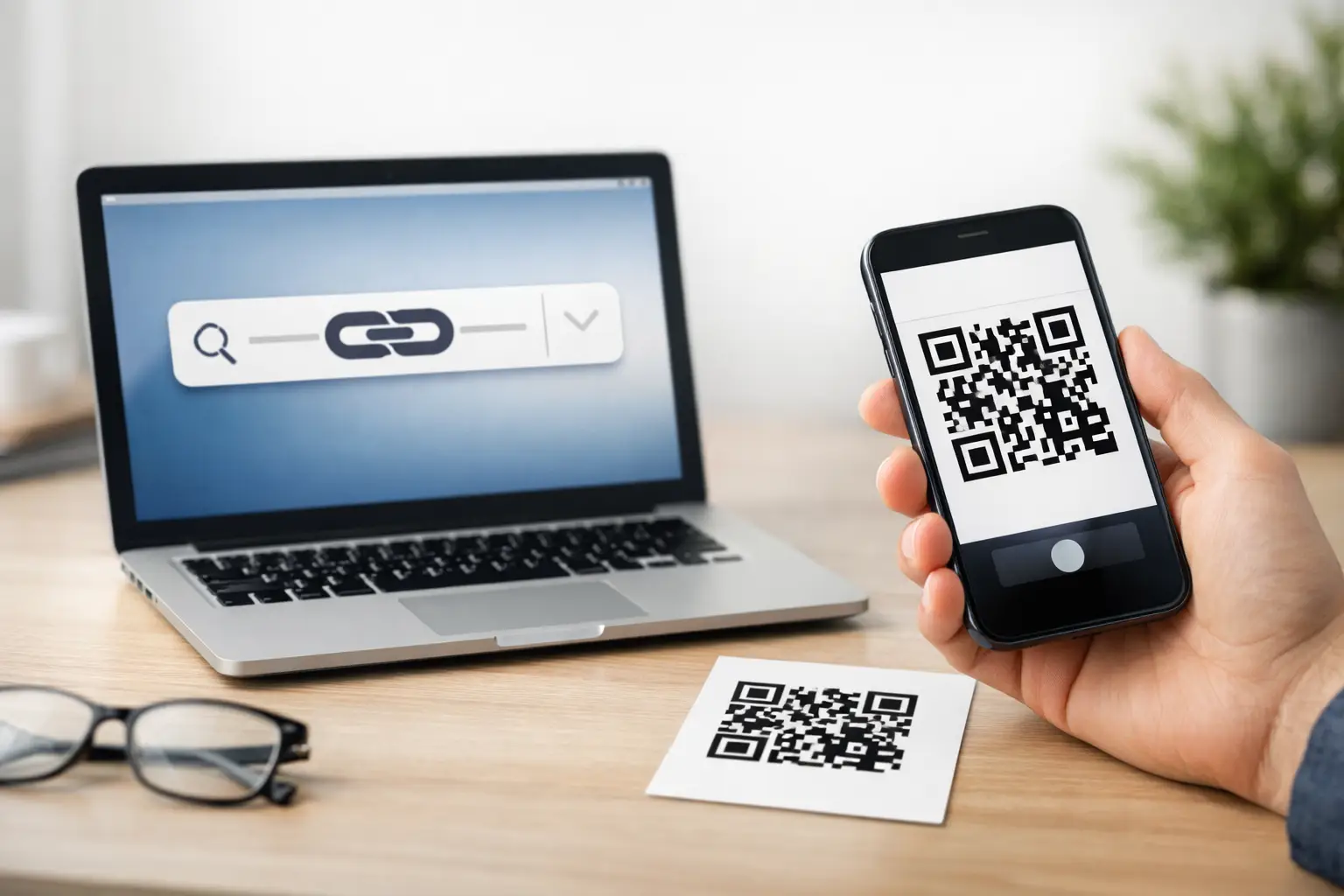
A link shortener vs QR platform decision is rarely about choosing a prettier way to share a URL. It is about how people reach your offer, what happens after they arrive, and whether your team can measure and improve the journey. A consultant sharing a proposal, a retailer promoting an in-store offer and an event organiser selling tickets may all use the same destination, but the distribution method changes the result.
A short link works wherever someone can click. A QR code works wherever someone can scan. The best setup often connects both to the same managed destination, so campaign performance stays visible even when audiences move between screens, print and physical spaces.
Link shortener vs QR platform: the practical difference
A link shortener turns a long URL into a concise, shareable link. The strongest platforms also let you use a custom domain, edit the destination later, add tracking parameters and review click data. That makes short links useful for email campaigns, social posts, messages, documents, ads, creator profiles and any channel where a person can tap or click.
A QR platform creates scannable codes that open a destination from a phone camera. QR codes are particularly effective when the audience is already in a physical location or looking at an offline asset. Think menus, packaging, posters, exhibition stands, receipts, table cards, product labels and printed brochures.
The overlap is substantial. Both tools can direct people to a page, booking form, payment link, digital product or campaign. Both can provide analytics. The difference is the starting behaviour: clicking is native to digital content; scanning bridges a physical object or screen to a mobile action.
That distinction matters because every extra step affects conversion. Asking someone to type a web address from a poster creates friction. Adding a QR code to a social post viewed on the same phone can do the same, because the user must take an additional action rather than simply tap a link.
Where a short link does more work
Short links are built for distribution at speed. They keep messages readable, reduce the visual noise of long URLs and give your brand more control over what people see before they click. A branded link also signals that the destination belongs to your organisation, which can improve confidence when you are sharing payment pages, booking forms or time-sensitive offers.
For digital campaigns, short links are usually the primary asset. You can place a different link in a newsletter, LinkedIn post, WhatsApp message and partner placement, then compare clicks by channel. If the destination changes, a managed short link can often be updated without replacing every printed or published reference.
They are also more flexible for teams that work across systems. Developers may generate links through an API. Marketers may add them to campaign templates. Sales teams can use them in proposals. A creator can place them in a link-in-bio page. The link becomes a trackable distribution layer rather than a simple redirect.
There is a trade-off. A short link cannot solve the problem of getting an offline audience online. If a passer-by sees your campaign on a window display or a conference banner, there is nothing to click. This is where QR codes earn their place.
Where a QR platform has the advantage
QR codes remove the need to remember, type or search for a destination. A customer can scan a code on a product package and reach instructions, a reorder page or a support form in seconds. An attendee can scan at a venue to see the agenda, save contact details, book a follow-up meeting or buy a ticket.
Dynamic QR codes are especially valuable. Instead of permanently encoding a final destination, they point to a managed URL that you can redirect later. This protects printed materials from becoming outdated and gives you a clearer view of scan activity over time.
A capable QR platform should give you more than a black-and-white square. You need dependable code generation, enough design control to keep the code recognisable, error correction for real-world use and scan analytics that distinguish campaigns. If a QR code is placed on five different posters, do not use the same code on each one if you want useful reporting. Create a code and destination structure that identifies placement, location or campaign.
QR codes are not automatically high-converting. Poor contrast, tiny sizing, awkward placement and a vague call to action all reduce scans. A code beside the words Scan me is weaker than one that states the benefit: Scan to book your place, Scan for the full menu, or Scan to claim 10% off. The destination must also match the promise immediately.
The real question: separate tools or one system?
Many businesses begin with a basic shortener and a separate QR generator. That can work for a small, occasional campaign. It becomes harder to manage when links lead to different tools for bookings, payments, forms, email sign-ups, events and products.
The operational cost is not just another subscription. It is fragmented data, inconsistent branding and time spent checking which destination is live. If a campaign performs well, you need to know whether it created clicks, scans, contacts, bookings or revenue. A dashboard that reports only traffic leaves the most valuable part of the journey disconnected.
A unified platform is more useful when the link or QR code is expected to produce an action. For example, a restaurant could use a QR code on table cards to collect email subscribers, then send a follow-up offer. A consultant could share a branded short link that leads to a booking page and records the enquiry in their contact list. A nonprofit could put a QR code on fundraising materials that opens a payment page, tracks scans and supports later outreach.
This is the operating model behind flnk.it: managed short links and QR codes can sit alongside landing pages, contact management, bookings, email campaigns, ticketing and Stripe-powered payments. The point is not to force every campaign through more features. It is to keep the features that matter connected when a campaign grows.
Choose based on the audience moment
Start with where the audience will encounter your message. If they are reading an email, browsing a website, using social media or receiving a direct message, lead with a short link. It is the natural action for that environment.
If they are standing in a shop, attending an event, reading a leaflet or looking at product packaging, lead with a QR code. Their phone is the bridge between the physical prompt and the digital destination.
Use both when a campaign crosses channels. A launch poster can carry a QR code, while the accompanying social campaign uses a branded short link. Both can direct to the same offer, but each should carry its own campaign identifier. This lets you compare not only traffic volume but also outcomes. Did the poster generate more bookings? Did social generate more sales? Did one location produce more repeat customers?
The destination should determine the technology around it. A simple informational page needs basic tracking. A booking, checkout, registration or lead capture flow needs stronger reporting, reliable integrations and a process for following up. Do not treat the QR code or short link as the campaign itself. It is the entry point to a measurable journey.
Build for action, not just scans and clicks
Before publishing, decide what success looks like. It may be a booked consultation, a ticket sold, a payment collected, a subscriber added or a product download completed. Then make the destination short, mobile-first and focused on one next step.
Give every important placement its own tracked asset. Name links and QR codes consistently, such as spring-event-london-poster or june-newsletter-offer. Use branded domains where possible. Review performance regularly, then update destinations and calls to action based on what the data shows.
A link shortener is the better starting point for digital sharing. A QR platform is the better starting point for physical engagement. When both feed into one organised workspace, you can move from sending people somewhere to knowing what they did next. That is where a simple scan or click starts earning its place in your operation.
Comments (0)
Be the first to comment.
Leave a comment